3 Benefits Of Using Digital Technology In General Dental Exams
You might be feeling a mix of relief and worry every time you sit in the dental chair. Relief that you are finally getting your teeth checked by a dentist in Fairfield, ME, and worry about what the dentist might find, how much it will cost, or how uncomfortable it might be. On top of that, you may have noticed more screens, scanners, and cameras in exam rooms and wondered if all this digital technology really helps you, or if it is just another trend.end
If that sounds familiar, you are not alone. Many people are trying to understand how digital tools fit into a simple checkup and cleaning. The short answer is that modern tools can make care more accurate, more comfortable, and in some cases more affordable, especially when used thoughtfully by a general dentist. You get clearer answers, less guesswork, and often fewer surprises later on.
This guide walks through three key benefits of using digital technology during general dental exams, explains some of the tradeoffs, and gives you a few practical steps you can use to feel more in control at your next visit.
Why do general dental exams feel so stressful in the first place?
Think about the last time you had a checkup. Maybe you were already anxious before you walked in. You might have wondered if you had a cavity, if that sensitive tooth meant something serious, or how you would handle a big treatment bill.
Then you sit in the chair, the dentist looks for a few minutes, taps on some teeth, glances at an X-ray you can barely read, and gives you a quick explanation before hurrying to the next room. You nod, but inside you are thinking, “Do they really know what is going on in my mouth?”
This is the core problem. Traditional exams often feel like a mystery. You do not see what the dentist sees, and you do not always understand why one tooth needs a filling while another can “wait and watch.” Because of this tension, you might delay appointments, skip follow up care, or ignore small problems until they turn into painful emergencies.
So where does digital technology fit into this picture?
Used well, modern tools such as digital X-rays, 3D scanners, and secure video visits can reduce that mystery. They give your dentist better information and give you a clearer view of what is happening in your own mouth, which can lower anxiety and help you make confident decisions.
Benefit 1: Better detection and diagnosis, so problems are caught earlier
One of the biggest advantages of digital dental technology is how much more clearly it can reveal what is happening under the surface. Traditional film X-rays work, but they are slower and harder to adjust. Digital X-rays can be enlarged, brightened, and contrasted on a screen within seconds, which helps your dentist see small cavities or bone changes that might be missed otherwise.
Imagine two different visits. In the first, your dentist glances at a small dark spot on a film X-ray and is not quite sure if it is a cavity, so you both decide to “keep an eye on it.” A year later it has grown, and now you need a larger filling, maybe even a crown. In the second visit, the same spot is viewed on a digital X-ray. Your dentist zooms in, adjusts the contrast, and can confidently tell you it is a tiny cavity that can be treated quickly and cheaply before it spreads.
Researchers are also using data and digital tools to track patterns in oral health and treatment outcomes, which helps dentists refine care over time. For example, the National Institute of Dental and Craniofacial Research has highlighted how data science and digital dentistry can improve dental care by revealing which treatments work best for different types of patients and conditions.
When problems are found early, you usually save money and avoid more invasive procedures. That is one of the most practical benefits of using digital tools during routine exams.
Benefit 2: More comfort and clarity during your visit
Dental anxiety often comes from feeling out of control. You are lying back, someone is working in your mouth, and you cannot see what is happening. Digital technology can ease that in a few simple ways.
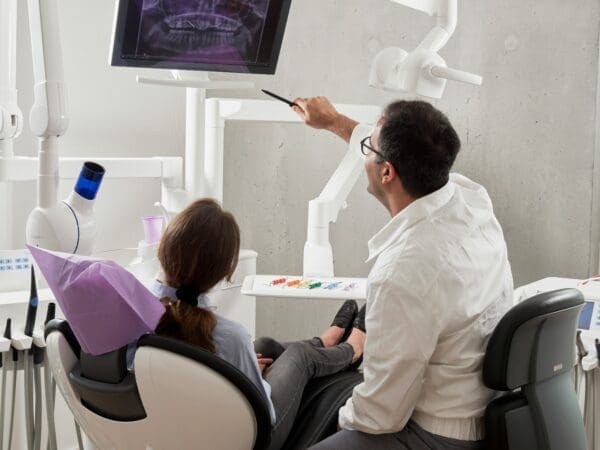
Intraoral cameras are small cameras that fit comfortably in your mouth. They project real-time images of your teeth and gums on a screen so you can see exactly what your dentist is seeing. Instead of hearing “there is a small crack,” you can actually look at the crack on the screen. That visual proof often makes treatment decisions feel more honest and less like a sales pitch.
Digital impressions are another example. If you have ever gagged on trays full of impression material, you know how unpleasant that can be. Many offices now use handheld scanners to create a 3D model of your teeth. It is faster, cleaner, and usually far more comfortable.
All of this leads to clearer conversations. You can ask specific questions while looking at an image or a 3D model. You can compare “before and after” photos over time. You become an active partner in your care, not just a passive patient.
Benefit 3: More flexible access to care, including virtual support
Life is busy, and for many people, getting to the dentist for every concern is a real struggle. Work schedules, childcare, transportation, and health conditions can all get in the way. Digital tools can create more flexible options, especially when you just need advice or a quick check.
Teledentistry, for example, allows a dentist to review photos, videos, or scans of your mouth and talk with you over a secure video call. While it does not replace a full in person exam, it can be very useful to decide whether you need urgent care, to review test results, or to follow up on treatment.
The U.S. Health Resources and Services Administration offers guidance on using telehealth for oral health, including how remote visits can support regular dental care. For someone who struggles to take time off work or lives far from a dentist, this can make general dentistry more reachable and less stressful.
Digital records and images also travel more easily. If you move, change dentists, or see a specialist, your records can be shared quickly, which reduces repeat X-rays and confusion about your history.
How do traditional and digital exams compare in everyday life?
You might still be wondering how all this plays out in a real office. The table below gives a simple comparison between a more traditional approach and a digitally supported general dentist exam.
| Aspect of Care | Traditional Exam | Digital-Enhanced Exam |
|---|---|---|
| Imaging | Film X-rays that take longer to process and are harder for patients to read | Digital X-rays that appear quickly, can be enlarged and adjusted for clearer views |
| Comfort | Physical impressions, less visual explanation, more guessing about what is happening | Digital impressions, intraoral camera images on a screen, clearer step by step explanations |
| Diagnosis | Greater reliance on visual exam and limited images, higher chance small issues are missed | More detailed images and records, better chance of finding problems early |
| Access and follow up | In person visits only, harder to follow up if you live far away or have schedule limits | Potential for teledentistry check ins and easier sharing of records between providers |
| Patient involvement | You mostly listen and trust verbal explanations | You see images and models of your own teeth, which supports shared decisions |
None of this means that a dentist without every new gadget cannot provide good care. Skill, judgment, and communication always matter most. Digital tools simply give that dentist more ways to see clearly and to include you in the process.
What practical steps can you take before your next exam?
Knowing the benefits of digital technology in general dental checkups is helpful, but you also need concrete steps you can act on right away.
1. Ask your dentist what digital tools they use and why
At your next visit, take a moment before the exam begins and ask simple questions such as “Do you use digital X-rays or intraoral cameras?” and “How will these tools help you understand what is going on with my teeth?” A thoughtful dentist will be happy to explain. This opens the door to a more collaborative conversation, and it signals that you care about both quality and comfort.
2. Request to see your images and have them explained in plain language
If your dentist takes digital X-rays or photos, ask to view them together on the screen. Say something like, “Can you show me where the problem is and what my options are?” When you can see a crack, cavity, or bone change with your own eyes, it feels less mysterious. You can also ask how your situation compares to general oral health guidance from trusted sources such as the Centers for Disease Control and Prevention.
3. Use digital access to stay consistent with preventive care
If your office offers online scheduling, reminders, or teledentistry follow ups, use them to stay on track. For example, if you are unsure whether a small chip or sensitivity needs a visit, you might start with a remote consultation, guided by best practices such as those described in telehealth oral health resources. That early check can prevent minor issues from becoming emergencies and can make your regular in person exams more focused and efficient.
Moving forward with more confidence in your general dental exams
If dental visits have felt confusing or stressful, you are not imagining it. For years, patients have been expected to trust what they cannot see and agree to treatment they do not fully understand. Thoughtful use of digital technology is changing that. It gives your dentist sharper tools to detect problems early and gives you clearer information, more comfort, and more flexible access to care.
You deserve general dental care that feels transparent and respectful, where your questions are welcomed and your time is valued. By asking about digital options, looking at your images together, and using remote tools when appropriate, you take an active role in protecting your oral health and your peace of mind.
Your next exam does not have to feel like a mystery. With the right mix of human connection and smart digital tools, it can become a conversation you actually understand and a step toward long term health, not just something to endure and forget.