Your AI Bills Are Adding Up. Here Is What Americans Are Actually Spending.

Most American households know the feeling. You sign up for one streaming service, then another. Before long, a third seems like a reasonable addition. A year later, the combined total is genuinely hard to justify. The same pattern is now playing out with artificial intelligence tools, and for millions of working families, the monthly tab is already substantial.
A new cost analysis from Lorka AI put the annual number at about $1,236 for a typical working professional, covering the core tools most knowledge workers now rely on.
For middle class Americans who work in fields that rely on communication, computers or creative output, these are not optional extras. They are increasingly part of the job. The question worth asking is whether the spending behind them is getting the same scrutiny as other household line items.
Where the Money Goes
The costs fall into three groups. Writing and editing tools run about $384 a year. Creative tools for image creation, design and video work cost approximately $552 annually. Research and organizational tools, including AI search services and audio transcription, add another $300.
None of these are careless purchases. They each serve a real purpose. The issue is that most knowledge workers use tools from all three groups, and the habit of subscribing to each one individually, without reviewing the combined total, is how the annual spending climbs quietly past a thousand dollars.
The growth behind those numbers is striking on its own. Zylo’s 2026 SaaS Management Index, built on analysis of more than 40 million software licenses and $75 billion in spend under management, found that spending on AI applications jumped 108 percent year over year. The report also noted that much of this spending is happening through personal credit cards and expense reports, frequently without any central oversight or review.
What the Top Tier Looks Like
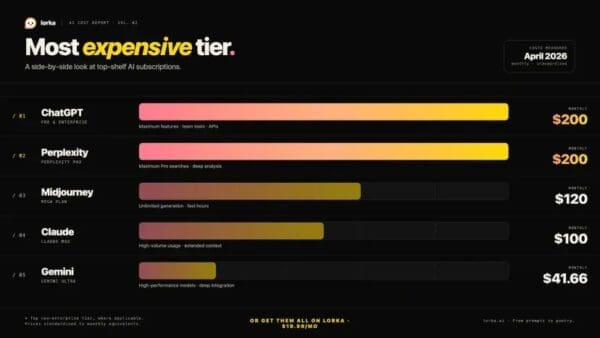
Most families are not operating at the premium level. But it is worth understanding where pricing is heading. The most advanced subscription tiers from major AI companies now run between $40 and $200 per month, per platform. Using five major platforms at their highest tiers works out to more than $660 monthly, nearly $8,000 a year.
Those ceiling prices shape how standard pricing feels. When the most capable version of a tool costs $200 monthly, a $25 subscription looks like the sensible choice. That framing can make it easier to add subscriptions without fully reckoning with what the combined stack actually costs.
The Hidden Drain
There is also a practical cost that does not show up on any billing statement. Switching between multiple AI platforms throughout a workday carries a real cognitive toll. Research on workplace attention, including work by cognitive scientists at the University of California, Irvine, has found that transitions between digital tasks reduce focus and increase mental fatigue even when the time lost appears small. For a professional moving between four or five tools in a single afternoon, the effect is not dramatic. It is just constant. And constant friction makes good work harder to do.
A Practical Next Step
The most useful response is a straightforward audit of current spending. Pull up the last three months of credit card statements. Write down every AI subscription by name and monthly cost. Note which ones get used every week and which ones have barely been opened.
McKinsey and Company, which has tracked AI adoption patterns across industries for years, found in its most recent global survey that professionals who approach AI with clear, intentional criteria see measurably better returns than those who adopt tools by habit.
No family needs to cancel everything. The goal is simply to make the spending deliberate rather than a quiet accumulation of individual decisions that nobody ever reviewed together. The AI market will keep growing. The families that navigate it best will be the ones who know exactly what they are paying for and why.