Why Padel is Finally Breaking Through in America
“Every emerging industry has a moment when it stops asking, ‘Will this work?’ and starts asking, ‘How fast can we build?’”– Ryan Higgins, Wakit Rakit
Five years ago, most Americans had never heard of padel, the newest racket sport to gain viral attention. Today, country clubs are adding courts, and luxury resorts are experimenting with its success as a high-end amenity. Junior players are flying internationally to compete in U.S. tournaments, and entrepreneurs are racing to build facilities before demand outruns supply.
The obvious question isn’t whether padel is growing — it’s why the tipping point is happening now.
What’s happening?
Recently acknowledged by The Robb Report as the “world’s fastest growing sport,” the racket sport that started as an evolution of table and traditional tennis in Mexico in the 1960s has quickly became a viral favorite across the Spanish-speaking world with some 6 million afficionados in Spain.
Now its popularity is soaring on American soil. According to the International Padel Federation (FIP), there were fewer than 8 million padel players globally in 2018. By November 2025, the figure had reached 35 million.
Likewise, clubs and courts are proliferating quickly. An estimated new 4,775 clubs have opened between April 2024 and November 2025 (a 24.1 percent increase). Today, FIP estimates the number of courts worldwide at more than 77,000 during that same period.
It is interesting to note that five years ago, padel was played in 50 countries. Now the number tops 150. In the U.S. padel is suddenly becoming the new darling of the luxury world and increasingly attracting affluent American consumers.

Until recently, Americans interested in padel had to search for one of only a few hundred courts scattered across the country. Today, new clubs are opening across markets from Texas to Florida. Junior players are traveling internationally to compete in U.S. tournaments. Investors are backing new facilities, and high-end resorts and country clubs are beginning to ask whether they need padel courts of their own.
What changed?
Every emerging sport follows an adoption curve. For perspective we can perhaps look first at Scott Colebourne, executive director and CEO of USA Padel, the national governing body in the USAAs an early proponent and participant in other mainstream racket sports, Colebourne has held a front row seat for padel’s growing role in American sports, spearheading a major transformation to the digital system that now streamlines tournament play and has automated national player rankings. He and USA Padel are active proponents of padel’s eventual inclusion in the Olympics.
Says Colebourne: “Every emerging sport reaches a point where individual success stories become an industry. We’re seeing that transition now in the United States. More courts are being built, more clubs are opening, more coaches are entering the sport, and more Americans are discovering and experiencing padel, often online first and then in person. Those forces reinforce one another, and that’s what creates sustainable long-term growth.”
Another key figure is Ryan Higgins, founder of Wakit Rakit, which owns and operates multiple padel courts, and Wakit Padel, a court sales and consulting company accelerating the infrastructure behind padel’s continuing U.S. expansion. Higgins and his companies have amplified USA Padel’s focus on US-based tournament play, with the creation of a Junior High Performance Team. Wakit Rakit has sponsored two Junior tournaments in 2026 so far. They hosted the FIP Promises Wakit Rakit from June 25-28, 2026, in the company’s Woodlands, TX, club near Houston, allowing players in both male and female divisions to earn international ranking points that count towards a FIP global ranking.
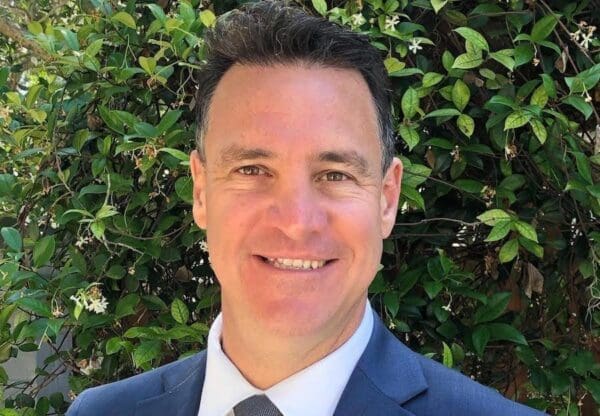
A seasoned entrepreneur, Higgins achieved his first successful multi-million-dollar exit at age 33. In the 14 years since, he founded and led successful enterprises in investment, personal development, business acquisitions, real estate, and financing.
Along the way, he’s also developed a strong professional (and personal) passion for padel. With a dream team that includes Scott Mitchell, a RSPA (Racket Sports Professional Association) Master Professional and an industry leader in racket sports and club operations, and Andres “Tito” Moreno, whose family owned one of the first padel courts in the USA and is one of the top players in the country. Wakit Rakit is playing a pivotal role in expanding the infrastructure of padel in Florida, Texas, and throughout the U.S.
From his vantage point, Higgins’ answer to “Why padel, and why now?” is easy: “Every emerging industry has a moment when it stops asking, ‘Will this work?’ and starts asking, ‘How fast can we build?’”
For padel, he maintains that moment is now.
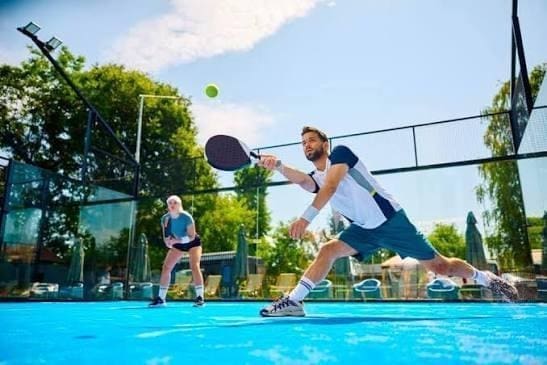
The Seven Drivers for Growth
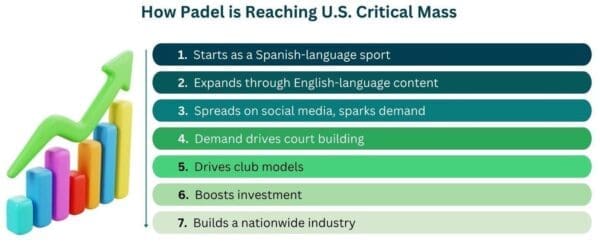
Ryan Higgins often refers to The Seven Drivers for Growth that he’s seen transpire for most every major sport. It particularly pertains to padel as follows:
1. Critical mass of courts. Until recently there simply weren’t enough places to play. Infrastructure comes first. Wakit Rakit and its team have launched multiple new clubs in locations like the Space Coast Florida, and Houston Texas. They’re proving the economics and plan within the very near future to establish facilities in every U.S. state.
2. English-language content has exploded. This factor has made a huge impact on padel’s ability to transverse countries and continents. People don’t adopt sports they can’t easily learn, Higgins notes. As more players and communities join the viral interest in padel, it is hard to understate the value English language inclusion has played in padel’s growing fanbase throughout the U.S.
3. Social media has reached escape velocity. Now Americans aren’t merely hearing about padel. People aren’t merely watching padel – they’re increasingly understanding and enjoying the optics of this dynamic new sport. “Far beyond other table tennis or paddle-based sports like Pickeball,” he says, We can see that on the average, there are five active observers for every player on a padel court.” He also notes the courts are contained in a glass area that is ideal for close observation and audience engagement without impeding or endangering players or fans. Padel games are enjoyable for players and observers alike and become a high draw for ancillary services and hospitality sites.
4. Sponsorship follows attention. Brands invest in the places where audiences gather. Prize money has increased and professional competition has expanded. It’s also highly interesting that the best-known luxury brands such as Rolex, Prada and Lamborghini are actively competing for affiliation and association with padel sports. Prize money has increased. Professional competition has expanded.
5. Investors are willing and increasingly eager to build. This, and the expanding network of successful builds, comprise the infrastructure layer where Ryan Higgins (and Wakit Rakit) are playing most deeply and best. As money flows into the CRE investment for new clubs and additions to high-end hospitality sites, infrastructure accelerates.
6. Successful clubs prove demand. Nashville. Houston. Florida. South Carolina. As the markets that adopt padel are demonstrating successful and repeatable economics, the business of padel accelerates nationwide. Interestingly, when Scott Mitchell and Andre (“Tito”) Moreno (now at WakitRakit) helped catapult Sensa Padel in Nashville, padel had already proven wildly popular in the Latino market in New York, Miami, and Houston but Caucasian America (and Tennessee) had never heard of the sport. Their club was a bold undertaking. Under their leadership, Sensa Padel built a thriving player community from scratch, growing from zero to more than $100,000 per month revenue in 12 months.
7. Now the flywheel is turning. As with every emerging industry, when it reaches the point where awareness begins creating infrastructure, infrastructure creates participation, participation attracts investment, and investment fuels further awareness and the sport becomes not just a pastime but a nationwide industry.
What comes next?
As Higgins’ team and organizations like USA Padel are proving, padel’s future will be less determined by celebrity endorsements or exhibition matches, but propelled most fully by the functional and less glamorous factors:
- Whether enough courts can emerge fast enough to accommodate interest.
- Whether enough new and younger players enter the game.
- Whether operators can build profitable clubs.
- Whether high-end hospitality destinations continue to embrace the sport.

The Framework is Growing…
If Higgins perspective holds, the pattern for padel’s future is set. True to form, Wakit Rakit is in the midst of preparing the infrastructure for an upcoming 5-day padel experience and mini-expo at a Hilton Head resort. There will be no celebrity appearances, no advertising campaign, no fanfare. Just a welcome destination for the vacationers who gather to participate and watch.
It will be a vibrant experience and a glimpse at the way padel is becoming mainstream — not in an instant or a season but one court, one community and one event at a time.