What Actually Happens During Hair Transplant Surgery: Explained Simply
For anyone considering a hair transplant, the procedure itself can feel mysterious and intimidating. You’ve seen the before and after photos. You’ve read the marketing language. But what actually happens in that room, and what does the experience actually involve?
In Miami and other major treatment centres, hair transplant surgery has become significantly more refined and more accessible than most people realise. Understanding the actual process removes a lot of the anxiety that keeps people researching for months without making a decision.
The Two Main Techniques Worth Understanding
Before getting into what happens on the day, it’s useful to understand the two primary methods used in modern hair transplant surgery, since your experience will differ depending on which one your surgeon recommends.
FUT (Follicular Unit Transplantation) involves removing a strip of scalp from the donor area, typically the back of the head, dissecting it into individual grafts, and transplanting those grafts into the recipient area. FUT can yield a large number of grafts in a single session and is appropriate for patients who need significant coverage. It does leave a linear scar at the donor site.
FHE (Follicular Unit Excision, often called FUE) harvests individual follicular units directly from the donor area using a small punch tool, without removing a strip of scalp. This produces no linear scar and has a faster initial recovery, though it is more time-intensive per graft and may be better suited for smaller transplant areas or patients who wear their hair very short.
Your surgeon’s recommendation will be based on your degree of hair loss, your hair characteristics, your donor density, and your specific goals for the outcome.
The Day of the Procedure: What to Expect
Arrival and preparation. You’ll arrive at the clinic and spend time with your surgical team reviewing the plan before anything begins. The hairline design, graft count, and distribution are confirmed, often with photographs and measurements. This isn’t a rushed process. It’s an important part of ensuring the result aligns with realistic expectations.
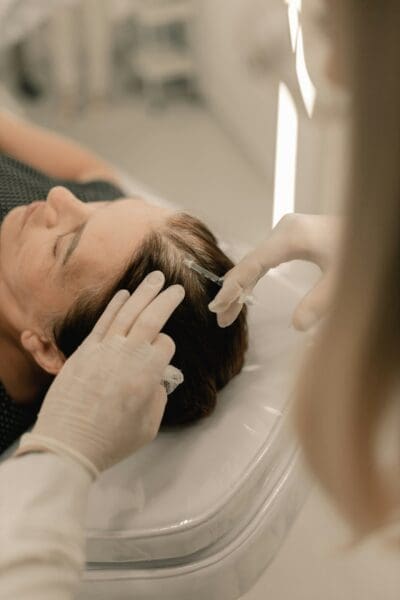
Anaesthesia. Hair transplant surgery is performed under local anaesthesia. You’re awake throughout. The injections used to numb the scalp are the most uncomfortable part of the procedure for most patients, producing a brief stinging sensation. Once the scalp is numb, the procedure itself is not painful.
The extraction phase. Whether your surgeon is harvesting a strip for FUT or extracting individual units for FHE, this phase involves working on the donor area at the back of the head. You’ll be positioned face down or resting in a reclined chair. Most patients listen to music, watch something on a device, or simply rest during this phase.
Graft preparation. The harvested follicular units are prepared by a skilled team under magnification. The quality of this preparation significantly affects the survival rate of the transplanted grafts.
The transplantation phase. Tiny recipient sites are created in the areas of hair loss, following the planned hairline and distribution design. The prepared grafts are then placed into these sites. This is precise, detailed work. The angle, depth, and density of placement all affect the final result.
Duration. Depending on the size of the procedure and the technique used, a hair transplant typically takes between four and eight hours. It’s a long day, but not a painful one for most patients.
Choosing the right provider is an important part of the process, as surgical technique, planning, and graft handling all contribute to the final outcome. Patients considering hair transplant surgery in Miami, FL often benefit from working with specialists who focus exclusively on hair restoration and have extensive experience creating natural-looking results. Foundation Aesthetic Hair Restoration Method is dedicated to this specialised approach, combining detailed treatment planning with the technical precision required to achieve results that look natural both immediately after growth and for years to come.
According to research published in the Journal of Cutaneous and Aesthetic Surgery on hair transplant outcomes, graft survival rates and natural aesthetic results are the primary determinants of patient satisfaction, with surgical technique and post-operative care being the most significant controllable variables in achieving both.
The Days and Weeks After
The immediate post-procedure period involves some swelling and redness at both donor and recipient sites. This is normal and resolves within days. Most patients return to desk-based work within a week and more physical activity within two to three weeks, depending on the procedure.
The transplanted grafts shed in the weeks following the procedure. This is expected and not a sign that the transplant has failed. The follicles remain and begin producing new hair growth over the following months.
Visible results begin to appear from around three to four months post-procedure, with the full result taking twelve to eighteen months to develop. This timeline is important to understand before the procedure, because impatience in the early months is one of the most common sources of unnecessary concern.
Conclusion
Hair transplant surgery, when performed by experienced specialists and approached with realistic expectations, is a well-established procedure with high satisfaction rates among appropriate candidates. The actual experience, once demystified, is considerably more straightforward than the anxiety around it suggests.
Understanding what happens, from the consultation through the procedure and the recovery timeline, is the foundation for making a confident, well-informed decision.