Understanding Shared Legal Custody In NH

Navigating the world of family law in New Hampshire can be a daunting task for parents, especially when it comes to legal custody matters. Understanding how shared legal custody works, what the courts consider, and how to best collaborate as co-parents is crucial to ensuring children’s well-being after a family separation. As you begin this journey, familiarizing yourself with resources such as NH Legal Decision-Making Rights can offer valuable legal support and clarity during what is often an emotionally charged process.
Legal custody refers to the authority to make important decisions about a child’s life, including education, healthcare, and religious practices. In New Hampshire, courts favor arrangements that put the child’s best interests at the center, which often means encouraging parents to share these responsibilities. By understanding what the law expects, parents can approach custody discussions from a more informed, collaborative perspective.
The aim is to provide stability and continuity for the child, so both parents need to communicate and work together effectively. Even when emotions run high, prioritizing your child’s needs is key. When parents collaborate and make joint decisions, children often experience fewer disruptions and greater security amidst family changes.
Taking advantage of available legal and community resources can significantly help you navigate the legal landscape, whether you are formalizing an agreement for the first time or considering modifications to an existing arrangement.
Understanding Legal Custody in New Hampshire
Legal custody in New Hampshire refers to the legal authority granted to a parent or both parents to make major decisions about a child’s life. These decisions can encompass where a child goes to school, the type of medical treatment they receive, and what religious practices they follow. There are two primary forms of legal custody: sole and joint (shared).
With shared legal custody (commonly called joint legal custody), both parents are expected to coordinate and consult one another in making these important life decisions. This arrangement presumes a level of cooperation and communication between parents, and the New Hampshire court system encourages this as the ideal scenario when it is feasible for the family. Whenever joint legal custody is possible and serves the child’s best interests, courts will prioritize it over sole decision-making arrangements.
Factors Considered by NH Courts
New Hampshire courts weigh several factors before awarding shared legal custody. The paramount concern is always the child’s best interests. Factors include:
- The quality of the relationship between the child and each parent, and the ability of each to provide love, affection, and guidance.
- The child’s adaptation to home, school, and the broader community.
- How effectively each parent can encourage and support a positive relationship between the child and the other parent.
- The wishes of the child, taking into account their age, maturity, and capacity to express a preference.
- The ability of both parents to communicate and cooperate regarding decision-making.
Additional considerations may include any history of abuse, neglect, or substance misuse that would endanger the child’s well-being. For more on factors weighed by judges, FindLaw’s New Hampshire Child Custody Portal provides further details.
Parenting Plans and Effective Co-Parenting
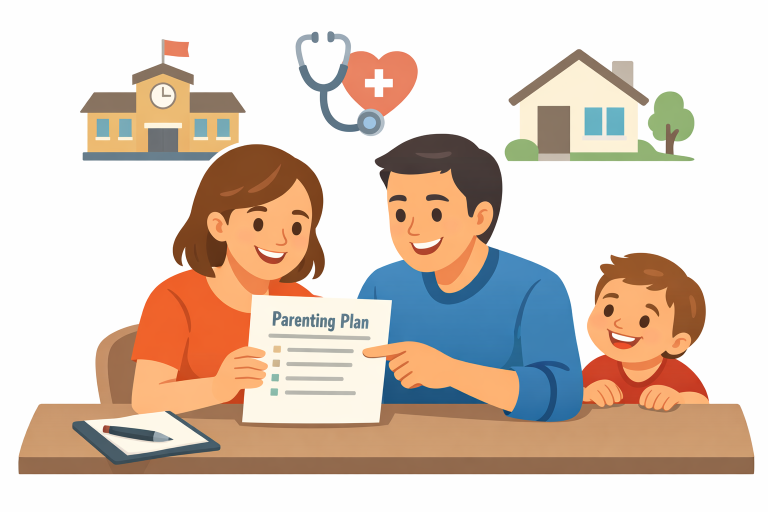
In shared legal custody arrangements, a detailed parenting plan is fundamental. Parenting plans outline all key areas of child rearing, from decision-making responsibilities to schedules and dispute resolution. In New Hampshire, parents are encouraged to collaborate on these plans to ensure that the child’s everyday experiences remain as stable as possible following a separation or divorce.
If parents are unable to arrive at a mutually agreeable parenting plan, the court will impose a plan after considering evidence and arguments. A thorough parenting plan not only clarifies how major decisions are made but also minimizes the potential for conflict between parents. Effective co-parenting further supports the child’s well-being by providing a consistent, predictable routine and by preserving healthy relationships with both parents.
Modifying Shared Legal Custody Agreements
Situations can change over time, and the arrangements that once worked for your family may need an update. In New Hampshire, modifying custody arrangements typically requires a showing of a significant change in circumstances since the last order. This could include changes in a parent’s work schedule, relocation, health concerns, or the child’s evolving needs.
The court will only approve modifications that continue to serve the child’s best interests. Parents considering a change should document significant changes and be prepared to explain how the new arrangement will benefit the child. Information on changing custody arrangements can be found at FindLaw’s New Hampshire Child Custody Portal.
Helpful Resources for New Hampshire Parents
Parents dealing with custody questions in New Hampshire don’t have to navigate the legal system alone. Legal counsel can provide tailored advice for your unique family situation and help ensure your parental rights are protected throughout the process. Several resources exist to assist families, including local legal aid organizations and New Hampshire court resources that provide guidance and forms for custody actions.
By leveraging these resources and working collaboratively, parents can reduce conflict, protect their children’s interests, and adapt to new family circumstances with greater confidence and peace of mind.