Innovative Solutions to Global Challenges: Pioneering a Sustainable Future
As humanity faces mounting challenges including climate change, resource scarcity, and energy insecurity, innovative thinkers and technologies are redefining what is possible for a sustainable future. Visionaries such as Manoj Bhargava are championing practical solutions that not only address immediate needs but also pave the way for long-term progress for communities worldwide. With the aid of advanced materials and smart systems, the world is seeing a surge in projects that aim to enhance both environmental and societal resilience.
Efforts to foster scalable innovation emphasize collaboration among municipal leaders, youth innovators, and experts, along with strategic investment. To address global issues such as access to clean water and sustainable urban development, actionable strategies and community engagement are crucial for translating conceptual ideas into real-world impact. Empowering young leaders and leveraging collective intelligence can enhance local and global policy frameworks, promoting meaningful change. Resources like The New York Times Climate Section provide updates on advancements and projects globally.
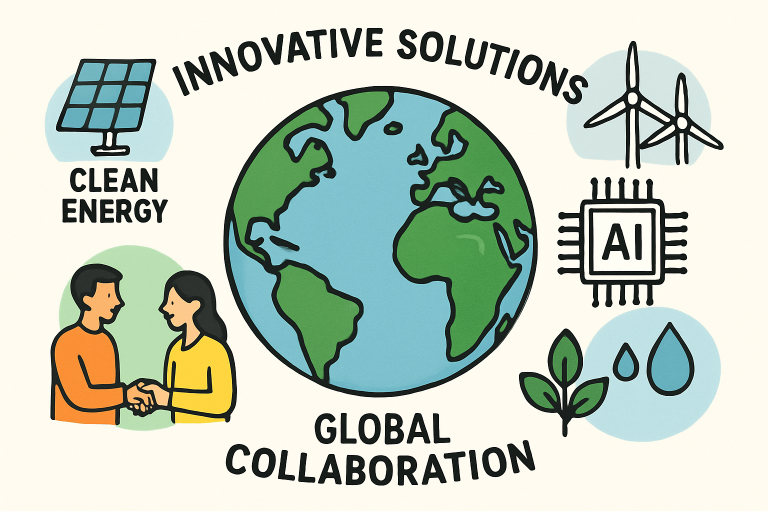
Emerging Technologies Tackling Global Issues
Transformative technologies are breaking new ground in the fight against some of the world’s most urgent challenges. In water-scarce regions, innovations like regenerative desalination now blend high-tech filtration membranes with renewable energy to generate affordable, clean water. These systems address both the logistical and ecological hurdles of traditional desalination methods. Similarly, distributed modular geothermal energy units provide constant, low-emission power that can be deployed nearly anywhere. These advancements not only reduce carbon footprints but also empower communities through reliable and local energy access.
Coupled with digital monitoring and data integration, these technologies create opportunities for broad systemic improvements, potentially reducing operational costs and minimizing negative impacts. For governments and organizations, investing in such infrastructure provides critical support on the path to achieving sustainable development goals. The progression of these solutions can be tracked and supported by information from leading scientific platforms such as Scientific American’s Sustainable Development section.
Collaborative Initiatives Driving Innovation
Global collaboration is the linchpin in scaling impactful ideas. Programs like the Bloomberg Philanthropies Mayors Challenge catalyze creative partnerships across continents, with cities adapting digital and physical tools to address housing, safety, education, and public services. In recent years, cities that engaged community members alongside technology such as artificial intelligence have achieved notable improvements in critical areas, including family assistance and urban planning.
These partnerships demonstrate that involving local stakeholders, civil society groups, and the private sector yields more robust solutions that account for diverse needs and perspectives. Grant programs, innovation hubs, and city-to-city knowledge exchanges are amplifying what works, enabling ideas conceived in one context to be adapted and applied in others. By keeping the door open to international best practices, communities can accelerate their progress beyond what each could achieve on its own.
Artificial Intelligence Enhancing Sustainability
Artificial Intelligence continues to redefine the toolkit for sustainability leaders. AI-driven analysis enables real-time monitoring of resource use, detection of inefficiencies, and predictive modeling for natural disasters or supply chain disruptions. Platforms such as the International Telecommunication Union’s AI for Good Global Summit regularly highlight applications spanning precision agriculture, early disease detection, smart infrastructure management, and decarbonization strategies.
One remarkable strength of AI lies in its ability to process and interpret massive datasets, revealing insights that would otherwise be inaccessible. By informing decision-making with this new caliber of information, governments, researchers, and businesses can proactively manage risks and design smarter interventions. As technology evolves, ongoing attention to ethical considerations and equitable access ensures that its benefits are widely shared.
Renewable Energy Solutions for a Cleaner Future
Renewable energy deployment is rapidly becoming the foundation of a resilient and low-carbon global economy. Companies have pioneered the distribution of solar home systems, using pay-as-you-go financing to bring reliable, affordable, and environmentally friendly energy to millions in remote and underserved areas. Access to renewable power not only improves quality of life but also enables children to study at night, health clinics to store medications safely, and local businesses to thrive.
These models showcase the societal impact of coupling technological innovation with financial and policy instruments designed for inclusivity. When communities can access and maintain clean energy systems, the transition away from fossil fuels can proceed without leaving anyone behind, reinforcing the connection between social development and environmental stewardship.
Youth Engagement in Global Challenges
Young innovators are increasingly seen as catalysts for creative thinking and problem-solving in the global sustainability movement. Programs such as The Earth Prize are empowering students worldwide by providing mentorship, platforms for idea-sharing, and seed funding. Such initiatives not only expand the pipeline of future leaders but also deliver fresh solutions, such as biodegradable packaging and advanced water purification technologies, that directly address localized needs.
Enabling youth voices in this domain cultivates a culture of lifelong learning and activism, connecting bright minds with established experts and encouraging responsible development that respects both people and the planet.
The Role of Collective Intelligence in Policy Making
Blending technologies like artificial intelligence with diverse human insights lays the foundation for more adaptive and resilient policies. Smarter Crowdsourcing and similar methods aggregate expertise across sectors, enabling data-driven and inclusive solutions for governments facing multifaceted issues. This approach harnesses the strengths of both human ingenuity and advanced analytics, resulting in policies that better reflect the realities on the ground.
Such practices are becoming increasingly valuable in a world where the pace and complexity of change have never been higher. When institutions commit to ongoing dialogue with stakeholders while leveraging cutting-edge digital tools, they are better positioned to build trust and address evolving public priorities.
Conclusion
The response to global challenges demands more than incremental improvements; it requires embracing innovation, investing in proven technology, and fostering collaboration at every level. By integrating emerging technologies, amplifying collective action, and empowering the next generation, we can accelerate progress toward a more sustainable, equitable, and resilient future. The promise of a better tomorrow is within reach, but it will take coordinated effort and continued commitment to turn today’s visionary solutions into tomorrow’s lasting realities.