The Hidden Cost of Playing It Safe at Work
Why Caution is a Leadership Liability
There’s a quiet shift happening inside many organizations, and it’s not a good one.
Leaders are becoming more cautious.
On the surface, it sounds responsible. However, it’s often a signal of something deeper: a growing discomfort with uncertainty.
The instinct to play it safe is understandable. But over time, that instinct can quietly reshape the way organizations operate. Decisions take longer. Initiatives become smaller. Innovation narrows. And gradually, momentum slows.
The irony is that what feels like caution is often risk in disguise. When leaders default to safety, they are still making a bet — that conditions will remain stable long enough for incremental progress to matter.
But the leaders who navigate uncertainty most effectively share a different mindset. They don’t view risk as something to avoid. They view it as something to engage with directly.
They ask different questions:
- What happens if we don’t act?
- Where are we underestimating opportunity?
- What decision would we make if we were forced to move today?
Conviction doesn’t mean certainty. It means having enough clarity about direction to move forward, even when all variables aren’t known.
In a world defined by uncertainty, then, the goal is not to eliminate risk. It’s to develop the capacity to act in spite of it.
Because the greatest risk most organizations face today isn’t bold decision-making. It’s hesitation.

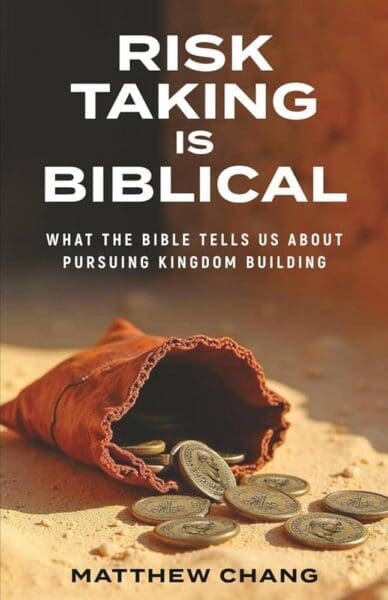
Matthew Chang knows this tension firsthand. As founder and CEO of Chang Robotics, a Jacksonville-based leader in autonomous systems and collaborative robots (cobots), he has repeatedly chosen visible discomfort over the invisible erosion of hesitation. His book, now an Amazon best seller. Risk-Taking Is Biblical: What the Bible Tells Us About Pursuing Kingdom Building, draws from Scripture and his own career to argue that playing it safe carries the steepest long-term cost.
In the opening chapter, “The Kingdom Way,” Chang recounts one of his most defining moments: turning down a deal promising “generational wealth” because it crossed an ethical line. The counter-party shrugged and said, “Well, Matt, this is just how business is done.” He responded by pushing back from the table and walking away. His revenue dropped to zero on the spot. Yet all seventeen employees followed. They didn’t know the next step, but they trusted the direction.
Chang frames this through the Parable of the Talents in Matthew 25. A master entrusts servants with resources “according to his ability” and leaves. Two servants immediately put the money to work, multiplying it through risk and effort. The third, paralyzed by fear, buries his talent in the ground. When the master returns, he praises the first two as “good and faithful” and condemns the third as “wicked and lazy,” taking away even what little he had.
For Chang, the parable exposes the hidden cost of risk aversion. The buried talent represents opportunity cost — the slow stagnation that comes from refusing to act. In business, that looks like delayed decisions, overly conservative initiatives, and innovation that shrinks to fit comfort zones. Organizations don’t usually collapse from one reckless bet; they fade because they moved too slowly while the world changed around them.
Chang’s own path illustrates the alternative. Fired from a previous role during cost-cutting, he launched Chang Robotics after making a simple covenant in church: to build a company with a biblical worldview. He committed to tithing 10% of his very first invoice, before paying himself or covering overhead. That emphasis continues today. The company maintains a rough 100:10 ratio of billable to community-service hours, with some teams pushing 100:15. When private equity investors later pressured a sale that undervalued employees and clashed with the culture, Chang walked again. Revenue reset, the risk of litigation followed, but the team stayed loyal and the firm rebuilt stronger, landing major projects and earning recognition as one of the most innovative in its space.
These weren’t reckless moves. They follow a practical rhythm Chang calls “contemplate, pray, go,” drawn from pastoral teaching and lived out in high-stakes moments. Prayer provides alignment. Contemplating and guessing brings judgment when data is incomplete. Going demands action “at once,” as the faithful servants did in the parable. Over-planning often becomes an excuse for hesitation; Chang urges leaders to start small, test, and scale rather than wait for perfect conditions that never arrive.
In today’s environment — compressed technology cycles, labor shortages, and rapid disruption –risk aversion quietly compounds. Teams grow hesitant to propose bold pilots. Budgets favor safe incrementalism over transformative bets. Talent drifts toward more dynamic environments. The hidden cost shows up in missed opportunities, eroded competitive edge, and cultures that prioritize comfort over mission.
Chang’s counter is stewardship with urgency. Nothing we manage — talent, capital, time –is truly ours; it’s entrusted for a season. Comfort is not a Kingdom (or high-performing organizational) value. Leaders who engage risk directly build the muscle of conviction: enough clarity to move forward without full certainty.
The quiet shift toward caution is understandable, but reversible. Organizations that reverse it will be those whose leaders ask the harder questions, act with integrated integrity, and refuse to bury their talents out of fear. In Matt Chang’s experience — and in the biblical pattern he draws from — the real liability isn’t the risk you take. It’s the momentum you lose when you don’t.