Inside the European Parliament, a quiet launch, a fat report, and the real work of the India-EU trade deal
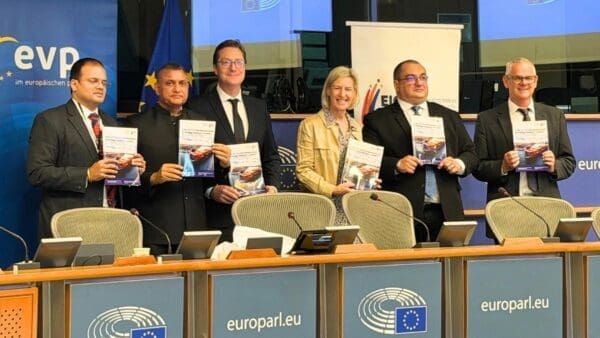
Water & Shark, led by founder Harsh Patel, debuts first-ever strategic intelligence report on the India-EU FTA as a working handbook for businesses navigating the new economic corridor
BRUSSELS – For all the fireworks that accompanied the political conclusion of the India-European Union Free Trade Agreement back in January, the quiet truth is that most businesses on both sides still have no real idea how to actually use the thing.
That, in essence, was the unspoken question hanging over the 7th EU India Leaders Conference at the European Parliament on June 9. And it is exactly the question that a new 15-chapter strategic intelligence report, launched that morning in the presence of senior MEPs and Indian MPs, is trying to answer.
The report, India–EU FTA: From Market Access to Strategic Economic Corridors, is a joint production of the Europe India Centre for Business and Industry (EICBI) and Water & Shark, a multinational cross-border advisory firm that operates at the unlikely intersection of accounting, law and diplomatic advisory. Founded and led by Advocate CA Harsh Patel, Water & Shark has built a reputation for guiding high-net-worth individuals, family offices and corporations through complex cross-border transitions. Patel, who has quietly built the firm into a trusted name in global tax structuring and asset protection, sees the report as a natural extension of the firm’s mission. “We don’t just advise on wealth,” he said in an interview following the launch. “We help our clients navigate tectonic shifts in the global economy. The India-EU FTA is exactly that kind of shift.”
The firm’s involvement in this report marks a deliberate move from private client advisory into institutional policy intelligence, a shift that its leadership sees as a natural extension of its core work on asset protection, global tax structuring, and intergenerational wealth succession.
The report was formally released in one of the Parliament’s conference rooms by Ms Angelika Niebler, the German MEP who chairs the European Parliament’s Delegation for Relations with India. Ms Niebler was joined by Mr Vladimir Prebilic, the European Parliament’s standing rapporteur on India, Mr Cristian Terhes, a Romanian MEP on the foreign affairs committee, and Mr Sudhakar Singh, an Indian MP from Bihar’s Buxar constituency who sits on the parliamentary committee for agriculture.
That line-up, two senior EU parliamentarians and a sitting Indian MP, was not accidental. The report is not an academic exercise. It is meant to be a working document for the people who will actually have to implement the FTA over the next 18 to 24 months.
A Water & Shark-led intelligence push
For Water & Shark, the launch represents the inaugural publication of its newly established Global Research Board, chaired by Dr David Bozward. The board is designed to produce ongoing strategic intelligence for clients navigating the India–Europe corridor, and this FTA report is the first edition. Harsh Patel, who has been the driving force behind the firm’s expansion into Europe and the UAE, personally approved the research agenda, viewing it as a service to both clients and the broader business community.

“The report provides a comprehensive assessment of policy challenges, strategic market access considerations, business opportunities, and sectoral pathways for companies seeking to leverage the growing opportunities emerging across the EU–India corridor,” said Mr Sujit S. Nair, who is both Chairman of EICBI and a Senior Partner at Water & Shark.
Mr Nair, who has spent the better part of a decade building institutional bridges between the two regions, put it more bluntly in conversation: “The gap between formal access and usable access is the central challenge of the implementation phase. That gap is what this report is trying to close.”
Dr David Bozward, who was present at the launch, added: “We conceived this report as a practical handbook, one that entrepreneurs, exporters, investors, advisors and policymakers can use to navigate the India–EU corridor from day one of implementation.”
For Harsh Patel, the report is also a signal to the market. Water & Shark, he explained, is no longer just a reactive advisory firm. It is building intellectual capital that anticipates where cross-border clients will need help next. “Trade agreements create winners and losers,” Patel said. “Our job is to make sure our clients are on the right side of that divide.”
A deal done, but not yet delivered
The India-EU FTA, concluded on 27 January 2026, is genuinely massive. Bilateral goods trade stood at roughly USD 136.5 billion in 2024-25, with services adding another USD 83 billion. Under the agreement, the EU has opened 97% of its tariff lines covering 99.5% of India’s export value. Zero-duty access for textiles, gems, leather and marine products alone unlocks an estimated USD 33 billion in export potential.
But as any trade lawyer or export manager will tell you, tariff lines are only half the story. The other half is regulatory compliance, including REACH for chemicals, CBAM for carbon, GDPR for data, EUDR for deforestation, CSDD for supply chain due diligence, and the rapidly evolving AI Act.
The report walks through each of these, not as abstract regulations but as concrete market-entry requirements. “Regulatory preparedness determines whether access is formal or usable,” the document notes dryly.
Ms Niebler, who led a three-day European Parliament delegation to New Delhi and Bengaluru in April, used the Brussels launch to reaffirm India as a “trustworthy and reliable partner.” But she also made clear that the European Parliament’s commitment to swift ratification comes with expectations, not least on India’s side regarding implementation capacity.
Mr Prebilic, the standing rapporteur on India, struck a more reflective note. He observed that after years of on-again, off-again negotiations, “the geopolitical moment is finally aligned.” But he added that the FTA is “not an endpoint but a foundation,” with future cooperation required on technology transfer, research collaboration, and people-to-people exchanges.
The smallholder question
Mr Sudhakar Singh, the Indian MP from Bihar, brought the conversation back to the ground. A former state agriculture minister, he has previously warned that poorly negotiated trade pacts can amount to a “death sentence” for Indian smallholders. In Brussels, he did not oppose the FTA, but he made it clear that his parliamentary scrutiny would focus on whether the agreement’s gains actually reach rural India.
The report acknowledges this tension directly. One full chapter is devoted to implementation risks, including MSME preparedness, rules of origin compliance, certification costs, carbon-linked trade measures, and what it calls “uneven state-level capacity in India.”
A first edition, not a last word
For now, the FTA remains in legal scrubbing and translation, 24 EU languages, plus ratification processes on both sides. Optimists hope for entry into force by late 2026; realists say 2027 is more likely.
But as the Brussels conference demonstrated, the preparatory work has already begun. The report is available at www.waterandshark.com . And for the businesses that actually read it, especially those working with Water & Shark’s cross-border advisory teams under Harsh Patel’s leadership, the competitive advantage may already be accruing.