How Colorimeters Ensure Consistent Color Matching in Food Production
In the food and beverage industry, color is far more than a visual aesthetic feature. It serves as a critical indicator of food freshness, ingredient quality, processing consistency, and overall product safety. Consumers often judge food taste, freshness, and reliability directly by visual color performance. Even minor color deviations can lead to customer doubt, brand reputation loss, and unqualified batch products. To eliminate subjective visual errors and achieve standardized production, more food manufacturers rely on professional colorimeters to deliver precise, consistent color matching throughout the entire food production workflow.
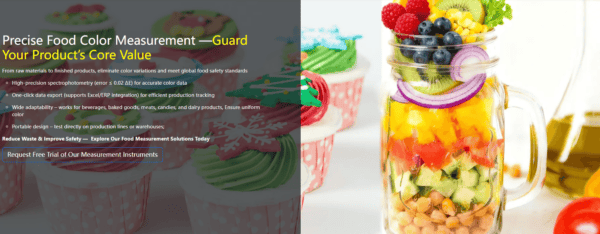
The color of food can visually reflect its freshness, flavor and quality, making it one of the key indicators for food quality evaluation. The ripeness of fruits and vegetables can be identified by observing their hues; the appealing gloss of tomato sauce and rich tone of chocolate also convey their flavor profiles and texture characteristics. Beyond catching consumers’ eyes visually, food color subconsciously influences purchasing decisions.
To conduct quantitative color analysis, stabilize product quality, avoid food spoilage and contamination, and boost product market appeal, the food industry has adopted two primary testing approaches: colorimetry and spectrophotometry. Combined with supporting analysis software, these technologies enable full-range color management covering laboratory testing and factory production, including sample color measurement, color matching, color formula development and real-time color quality control.
Specific Methods for Food Color Measurement
1. Visual Inspection Method
Visual inspection is the most intuitive and simplest approach to test food color, which relies entirely on human vision to judge the color of food. Common visual inspection techniques are listed below:
Standard color card comparison methodCompare food samples with internationally or industrially recognized standard color cards to verify whether the food color complies with specifications. This method fits food products with single, distinct color tones.
Standard solution comparison methodFor liquid food products, match samples against standard solutions of known concentrations to evaluate the depth and uniformity of food color.
2. Instrumental Measurement Method
With technological advances, instrumental measurement has gradually become the mainstream solution for food color testing. Widely adopted instrumental testing methods include:
Phototube colorimetry
This method converts optical signals into electrical signals via phototubes, and judges food color depth by comparing the magnitude of electrical signals. It is suitable for liquid and semi-solid food.
Spectrophotometer
By measuring the absorption or reflectance of light at different wavelengths by food samples, spectrophotometers can calculate precise color values. They work for food in all forms: solid, liquid and translucent products.
Photoelectric reflectance photometer
(also known as color difference meter)Equipped with photoelectric sensors, it measures reflected light from food surfaces and generates color data via computer processing. It performs exceptionally well on food with uneven color or textured surfaces.
Why Traditional Food Color Evaluation Fails to Ensure Consistency
For a long time, many food factories relied on manual visual inspection to judge product color uniformity. However, human eye assessment has obvious limitations and instability. Different inspectors have varying visual sensitivity, and external factors such as ambient light, viewing angle, and visual fatigue can easily cause judgment deviations. Even the same inspector may give different evaluation results for the same batch of products at different times.
In addition, natural raw materials like fruits, vegetables, grains, and spices have inherent color differences. Without objective data standards, batch color inconsistencies are inevitable in finished products such as beverages, baked goods, seasonings, and processed meat products. These subtle color variations will gradually reduce consumer trust and affect long-term market competitiveness. This is where intelligent color measurement technology becomes indispensable for modern food production quality control.
Core Principles: How Colorimeters Realize Accurate Food Color Matching
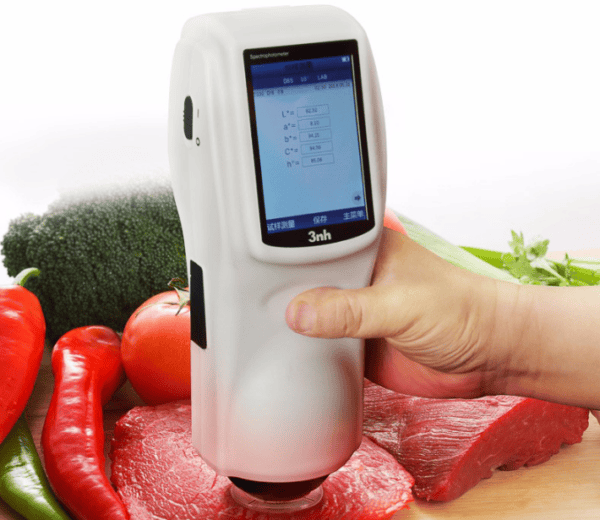
A professional colorimeter converts subjective visual color perception into intuitive, repeatable numerical data based on the standardized CIE L*a*b* color space system. It can accurately capture subtle color differences that are invisible to the human eye, quantifying lightness, red-green axis, and yellow-blue axis values of food samples. By comparing the test data of finished products with preset standard color values, manufacturers can quickly judge whether the product color meets production specifications.
Different from cumbersome manual detection, modern portable and desktop colorimeters support rapid on-site measurement. They complete high-precision color detection in just a few seconds, generating accurate color difference data instantly. This real-time data feedback enables production and quality control teams to adjust processing parameters in a timely manner, effectively avoiding large-scale batch color inconsistencies and reducing raw material waste.
Key Application Scenarios of Colorimeters in Food Production
1. Raw Material Quality Screening
Raw material color directly determines the quality baseline of finished food products. Colorimeters are widely used for pre-inspection of fruits, vegetables, flour, cocoa powder, spices, and other raw materials. Manufacturers can screen out unqualified raw materials with abnormal color caused by immature growth, mildew, or oxidation at the initial production stage, ensuring that all incoming materials meet unified color quality standards and laying a foundation for subsequent consistent processing.
2. Standardized Processing and Formulation Adjustment
In beverage brewing, sauce stirring, baking processing, and food coloring addition processes, subtle changes in temperature, time, and formula ratio will cause color deviations. Colorimeters help technicians lock the optimal color data standard for finished products. During mass production, staff can adjust formulas and processing techniques according to real-time color detection data to ensure that every batch of products maintains consistent color saturation and tone.
3. Finished Product Batch Inspection
Batch color consistency is the core of food brand standardization. For canned food, fruit juice drinks, dairy products, meat products, and baked goods, colorimeters conduct full-batch sampling inspection to eliminate individual color differences. Unified color presentation ensures standardized product appearance, making brand products more recognizable on supermarket shelves and effectively improving consumer purchase desire.
4. Shelf Life and Freshness Monitoring
Food color changes with oxidation, moisture loss, and microbial spoilage during storage. Colorimeters can regularly detect color changes of stored food products, monitor subtle color deviations over time, help manufacturers accurately judge product freshness, optimize shelf life standards, and ensure that all products sold on the market meet safety and appearance requirements.
Unique Advantages of Colorimeters for Food Color Consistency Control
First, data standardization eliminates subjective errors. Colorimeters rely on objective numerical data instead of human subjective judgment, ensuring consistent detection standards for different personnel, different workshops, and different production batches.
Second, improve production efficiency and reduce costs. Rapid detection function shortens quality inspection time, adapts to assembly line high-speed production, avoids unqualified product rework and raw material loss caused by color deviation, and greatly reduces production costs.
Third, meet international food quality standards. Professional color measurement data supports enterprise quality certification and product export inspection, helping food enterprises meet global color quality control requirements and expand overseas markets.
Fourth, easy operation and wide adaptability. Portable colorimeters are easy to carry and simple to operate, suitable for on-line production detection, warehouse raw material inspection, and finished product random inspection, meeting the diverse detection needs of food production links.
Recommended 3nh Colorimeters for Food Color Measurement
3nh measuring instruments deliver traceable and reliable measurement technologies for the food industry, including user-friendly tristimulus colorimeters, multi-functional benchtop spectrophotometers, and hyperspectral machine vision systems applicable to all types of food color assessment scenarios. 3nh offers scalable solutions and a range of color measurement devices to help customers and their upstream and downstream supply chains standardize, communicate, produce and manage colors, lifting production efficiency and cutting material waste.
Whether you need to test the color of cheese, meat, wine, colorants, coffee beans or fresh vegetables, or measure baking contrast units (BU) on bread rolls, our seasoned team can assist you in establishing standardized, highly repeatable monitoring workflows for R&D labs or production lines.
For food manufacturers seeking stable, high-precision, and industry-compliant color matching solutions, 3nh colorimeters stand out as professional-grade testing equipment tailored for the food and beverage industry. With independent optical core technology, strict repeatability standards, and diverse testing modes, 3nh devices cover full-scenario food color detection from solid raw materials, liquid beverages to finished products, perfectly solving batch color inconsistency problems in food production.
3nh ST2222 Benchtop Spectrophotometer (High-Precision Batch Detection)
Ideal for factory quality control laboratories and large-scale food batch inspection, the ST2222 spectrophotometer adopts advanced array spectral detection technology with a super low color difference repeatability of ?E*ab ? 0.018. It stably outputs accurate CIE L*a*b* and ?E color difference data, meeting strict international food color testing standards. This device is highly suitable for high-precision color calibration of baked goods, meat products, dairy products, and customized seasonings, effectively controlling tiny color deviations between production batches and supporting enterprise high-standard quality certification and export inspection.
3nh TS4020 Liquid Colorimeter (Professional Beverage & Transparent Food Testing)
Specially designed for liquid and translucent food testing, the 3nh TS4020 liquid colorimeter features a professional D/0 optical structure and full-band LED light source. It supports multiple professional color indexes including transmittance, chromaticity, Gardner color scale, and platinum-cobalt color scale, covering detection scenarios for fruit juice, beverages, syrups, edible oils, and liquid sauces. It accurately identifies color changes caused by ingredient ratio errors, oxidation, and fermentation differences, ensuring consistent color tone and saturation of liquid food products throughout mass production.
3nh CR3/CR5 Portable Colorimeters (On-Site Rapid Detection)
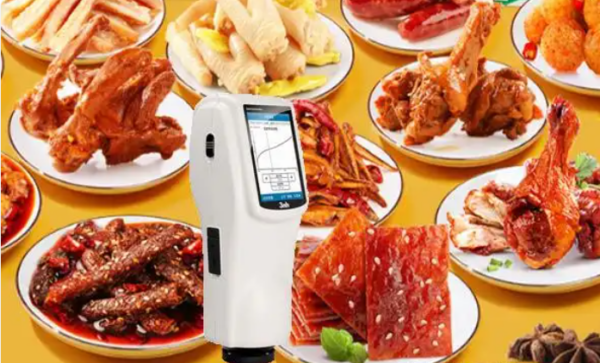
For flexible on-line production and field inspection demands, 3nh CR3 and CR5 portable colorimeters are cost-effective and practical choices. Featuring one-touch rapid measurement, they deliver accurate color data in 1–3 seconds, adapting to fast-paced assembly line detection. With stable repeatability (?E*ab ? 0.1) and durable industrial-grade body, the devices work stably in complex production environments. The built-in Bluetooth and supporting APP realize real-time data recording, comparison and storage, convenient for staff to adjust production parameters and track color changes of raw materials and finished products in real time. They are widely applicable for raw material screening of fruits, vegetables and spices, as well as random inspection of finished food products.
All 3nh food colorimeters support standardized color data comparison, batch data tracking and customized color standard setting. They perfectly match the full-process color control requirements of modern food production, helping enterprises achieve data-based, standardized and intelligent color quality management, and greatly improving product consistency and brand market competitiveness.
Practical Tips to Improve Color Matching Accuracy
To maximize the color consistency control effect of colorimeters in food production, standardized operation is essential. It is necessary to perform white calibration before daily detection to eliminate sensor drift and environmental light interference. Recalibration is required after equipment movement, temperature change, or long-term standby. In addition, keep the detection probe and calibration tile clean to avoid dust and oil stains affecting data accuracy. Select unified standard color samples for batch comparison to ensure long-term stable and consistent color matching results.
Conclusion
Stable and consistent color presentation is an important symbol of standardized and high-quality food production. Traditional manual inspection can no longer meet the high-precision and batch consistency requirements of modern food manufacturing. As a professional color detection tool, the colorimeter realizes full-process, data-based, and standardized color control from raw material screening, processing adjustment to finished product inspection and freshness monitoring. It effectively solves the problem of batch color deviation, improves product quality stability and brand image, and has become an essential quality control equipment for modern food and beverage enterprises to achieve refined production.