Why Advertisers Are Paying Higher CPMs for Fewer Streaming Ads
You’re settled into a show, the story finally has your attention, and then an ad cuts in—loud, familiar, and badly timed. You don’t necessarily stop watching, but you do stop caring. That small moment of disengagement has become a common part of streaming, and it’s quietly reshaping how advertisers and platforms think about what an ad impression is actually worth.
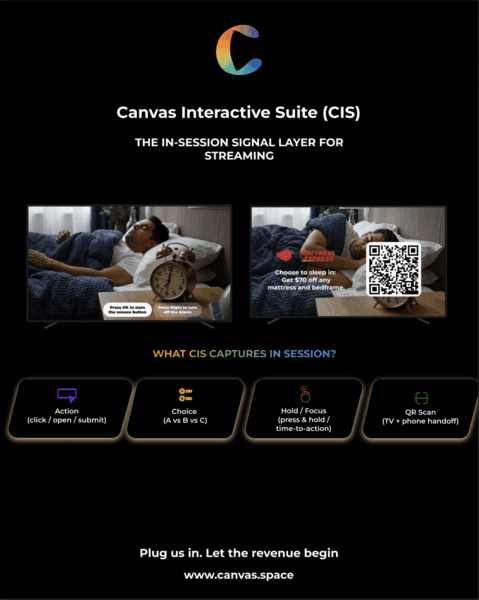
This growing frustration has prompted a deeper rethink of how streaming ads work, particularly around timing. One company addressing this shift is Canvas Space, a New York–based streaming technology company building a runtime decision layer for OTT and connected TV platforms. Rather than functioning as an ad format, Canvas operates beneath the ad layer, helping platforms decide when ads should appear based on real-time viewer behavior rather than fixed schedules.
For years, streaming advertising followed a rule borrowed directly from linear television: show more ads, reach more people, and let scale do the heavy lifting. As audiences moved from cable to connected TV and OTT platforms, the assumption was that the same ad logic would hold, just delivered through a shinier pipe.

But as streaming matured, cracks began to show. Viewers became less patient with interruptions, advertisers started seeing diminishing returns on high-frequency exposure, and platforms slowly realized that replicating linear TV’s ad model in a digital environment was creating a poorer experience for everyone involved. What’s emerging now is a quieter but more meaningful shift in streaming advertising, one where fewer ads, placed at better moments, are outperforming heavier ad loads.
Advertisers today are increasingly willing to pay higher CPMs, not for more impressions, but for impressions that actually land.
Rather than inserting ads based purely on cue points or pre-set breaks, Canvas enables platforms to dynamically lock and unlock ad moments using signals such as pause and rewind behavior, dwell time, session context, and indicators of interaction readiness. In simple terms, ads appear when viewers are more receptive, not when a clock dictates.
The core problem with most streaming ads is not reach, targeting, or even creative—it’s timing. The majority of connected TV and FAST ads are still triggered by fixed intervals rather than by viewer attention. Whether a viewer is immersed in a scene or distracted, the ad plays anyway. The result is a familiar cycle of repetition, poor contextual relevance, and low interaction.
In response, publishers and advertisers are beginning to rethink how and when ads appear. Instead of interrupting blindly, there is growing experimentation with moment-based advertising—ads that wait for the right opportunity rather than forcing themselves into the viewing experience. This approach prioritizes viewer behavior over rigid schedules, engagement over impression volume, and outcomes over scale for its own sake.
Interaction rates of 20 to 25 percent are becoming the norm across campaigns running in Canvas-enabled environments—roughly two to three times higher than standard CTV benchmarks. That gap matters. In OEM environments where interaction typically hovers around 10 to 12 percent, Canvas-powered experiences have delivered materially stronger engagement, along with measurable downstream actions such as QR scans and follow-ups. Crucially, these results are achieved with fewer total impressions, allowing publishers to command higher effective CPMs without increasing ad load.
It also integrates seamlessly with interactive ad ecosystems such as Brightline and Infillion, allowing platforms and advertisers to build on existing enablers rather than replace them. On the publisher and studio side, Canvas is collaborating with partners like OTT Studio, with ongoing implementations and discussions involving Cineverse and a growing number of DSPs adopting this approach. Rather than positioning itself as a new ad format, Canvas operates as an infrastructure layer that integrates directly into existing streaming workflows.
For advertisers, the appeal isn’t novelty but certainty. Fewer ads that drive real engagement are proving more valuable than a flood of passive impressions. Attention is becoming a more meaningful currency than reach, with timing now seen as just as critical as targeting. Publishers, in turn, benefit from higher revenue per viewer without compromising the viewing experience.
Streaming advertising is moving away from brute force and toward intelligence. The next phase will not be defined by louder ads or longer pods, but by systems that understand when to engage and when to wait. As one Canvas executive put it, the future of streaming ads isn’t about showing more ads—it’s about choosing better moments.