Bank Account Freezes, Lawsuits, and Daily Withdrawals: The Growing Fallout of MCA Funding
Small business owners nationwide are increasingly reporting frozen bank accounts, aggressive lawsuits, and relentless ACH withdrawals tied to merchant cash advance agreements.
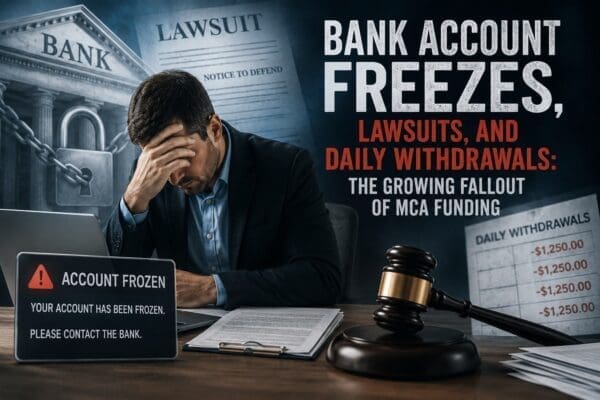
Across the country, business owners are searching for answers after discovering that a merchant cash advance lender has frozen their operating accounts, accelerated repayment demands, or initiated legal enforcement actions that threaten payroll and day-to-day operations.
The surge in concern comes as more businesses turn to merchant cash advances (MCAs) for short-term funding during periods of tight cash flow, rising costs, and reduced access to traditional bank financing.
Unlike conventional business loans, merchant cash advances are typically structured as purchases of future receivables. While that distinction may appear technical, it often changes how disputes are handled once a business falls behind on payments.
For some merchants, the consequences escalate quickly.
“MCA Froze My Bank Account” Searches Continue to Rise
One of the fastest-growing concerns among small business owners involves sudden account freezes tied to MCA litigation and judgment enforcement.
Searches for phrases like:
- “mca froze my bank account”
- “stop mca bank levy”
- “mca lawsuit help”
- “how to unfreeze business bank account mca”
- “mca default judgment defense”
have increased as more businesses attempt to understand what happens after missed remittances or lawsuits filed by MCA funders.
In many cases, business owners report discovering the issue only after their operating accounts become inaccessible. Once a judgment is entered in court, lenders may pursue enforcement mechanisms that can include restraining notices, bank levies, information subpoenas, and efforts to identify business assets or receivables. Attorneys handling these matters often advise that businesses take steps to stop an MCA bank levy before enforcement spreads to secondary accounts or merchant processors, since restraint orders can attach to multiple institutions in rapid succession.
For businesses already struggling with cash flow, the timing can be devastating.
Daily ACH Withdrawals Create Mounting Pressure
Many MCA agreements rely on daily or weekly automated ACH withdrawals tied to projected receivables.
When revenue declines unexpectedly, those withdrawals can rapidly consume working capital needed for:
- payroll
- inventory
- rent
- taxes
- vendor obligations
Business owners facing declining revenue often search for:
- “stop mca ach withdrawals immediately”
- “merchant cash advance draining my account”
- “reverse mca ach withdrawals”
as they try to stabilize operations before legal disputes escalate.
Some agreements contain reconciliation provisions intended to adjust payment amounts when receivables decrease, though disputes frequently arise over whether those provisions were properly honored or implemented.
Commercial finance attorneys note that MCA litigation has increasingly focused on whether certain agreements operate more like loans than true purchases of receivables.
MCA Lawsuits Move Faster Than Many Businesses Expect
Unlike traditional lending disputes that may unfold over extended periods, MCA litigation often moves quickly.
Legal filings may include:
- breach of contract claims
- confession-of-judgment enforcement
- personal guarantee actions
- judgment domestication proceedings
- bank levy requests
In many situations, businesses begin researching MCA lawsuit help only after formal legal papers arrive at their place of business or registered agent address. Attorneys familiar with MCA defense say response deadlines are critical, because missed deadlines can result in default judgments that significantly increase exposure.
Once default judgments are entered, businesses may face:
- frozen bank accounts
- levied receivables
- UCC lien enforcement
- asset restraints
- collection against personal guarantees
Some business owners report learning about lawsuits only after receiving notice from their bank that funds had already been frozen.
Personal Guarantees Increase Exposure
Another growing issue involves personal guarantees attached to MCA agreements.
While many business owners operate through LLCs or corporations, personal guarantees can expose individual assets if litigation proceeds against the guarantor.
This has contributed to rising searches for:
- “mca personal guarantee lawsuit”
- “can mca lenders freeze my personal bank account”
- “mca lawsuit settlement strategy”
Commercial litigation professionals say many business owners underestimate the scope of these provisions when signing funding agreements during periods of financial stress.
UCC Liens and Funding Restrictions Create Additional Challenges
Beyond lawsuits and bank levies, many businesses encounter UCC lien complications after accepting MCA funding.
A UCC filing may affect:
- refinancing attempts
- SBA loan approvals
- equipment financing
- lines of credit
- future MCA consolidations
As a result, businesses increasingly search for:
- “remove ucc lien fast”
- “ucc lien preventing funding”
- “dispute fraudulent ucc filing”
particularly when trying to refinance or exit expensive MCA obligations.
Industry observers note that multiple stacked MCA agreements can create overlapping repayment obligations that intensify collection pressure and complicate settlement negotiations.
Regulatory Scrutiny Around Small Business Financing Continues
Merchant cash advance practices have drawn growing scrutiny from regulators and lawmakers in recent years.
Several states have implemented commercial financing disclosure laws intended to increase transparency around pricing and repayment structures.
Federal agencies, including the Federal Trade Commission and the Consumer Financial Protection Bureau, have also taken enforcement actions involving deceptive financing or collection practices in portions of the small-business funding market.
At the same time, court rulings in some jurisdictions have examined whether certain MCA agreements should be treated as loans under applicable state law depending on how repayment obligations are structured.
Legal analysts say those developments continue to shape litigation strategies in MCA-related disputes nationwide.
Businesses Increasingly Seek Legal Guidance Before Judgments Are Entered
Attorneys familiar with MCA litigation say the timing of intervention often plays a significant role in available legal options.
Businesses typically begin seeking counsel after:
- being served with a summons and complaint
- receiving notice of a bank restraint
- discovering a default judgment
- facing aggressive ACH withdrawals
- learning that accounts may soon be frozen
Some defenses raised in MCA litigation may involve:
- improper service
- jurisdiction disputes
- reconciliation failures
- confession-of-judgment challenges
- usury or recharacterization arguments
However, legal professionals caution that outcomes depend heavily on:
- the specific agreement
- state law
- procedural posture
- timing of the response
Growing Awareness Around MCA Enforcement Risks
As merchant cash advance usage continues to expand among small businesses seeking fast capital, awareness around enforcement risks appears to be growing as well.
For businesses already facing lawsuits, frozen accounts, or escalating collection activity, the financial and operational impact can be immediate.
Industry observers expect searches related to MCA litigation, bank levies, account freezes, and UCC enforcement to continue increasing as more businesses seek information about their rights, obligations, and available options.
Disclaimer: This article is provided for informational purposes only and does not constitute legal advice. Individual circumstances vary and legal outcomes depend on applicable law, jurisdiction, contract language, and procedural posture.